Signs that soaring mortgage rates are now biting harder
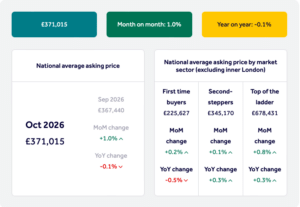
- The average price of a newly listed home rises by 1.0% this month (+£3,575) to £371,015. However, prices are virtually flat compared with a year ago (-0.1%) showing that the market remains very price-sensitive
- There are signs that soaring mortgage rates are now biting harder, with new sellers in more affordable and previously resilient parts of Great Britain setting lower asking prices as buyers face mounting affordability pressures:
- The average two-year fixed mortgage rate has risen to 5.55%, from 5.29% last month and 4.25% before the war in Iran started, adding around £250 a month to the cost of a typical new mortgage since February
- New sellers in four of the five lowest-priced parts of Great Britain have set lower asking prices this month, including falls of 2.0% in the North East and 1.9% in Scotland
- London asking prices rise by 2.5% this month, clawing back some of the 6.0% fall over the summer. However, prices remain 1.7% below last year, and wider data indicators suggest that this month’s rise is not evidence of a broader recovery
- The number of sales agreed is down 8% on the same period a year ago, however this is broadly in line with the year to date, with deals still being done and sales activity showing surprising resilience despite higher mortgage rates
- The Budget is adding a layer of uncertainty to decision-making. Some first-time buyers may be waiting for more detail on the Your First Home scheme, while others will be assessing what any announcements could mean for their wider household finances
National price increase masks mixed seller reactions to affordability pressure
The average price of a newly listed home rises by 1.0% this month (+£3,575) to £371,015, which leaves prices virtually flat compared with a year ago, down by 0.1%. However, the national increase masks mixed seller reactions as rising mortgage rates intensify affordability pressures in an already price-sensitive market. Rightmove’s daily mortgage tracker shows that the average two-year fixed mortgage rate has risen to 5.55%, from 5.29% last month, and 4.25% before the war in Iran started in February. The average monthly mortgage payment for a new mortgage has increased by around £250 since February, adding significant pressure to many buyers’ budgets. Higher borrowing costs now appear to be biting harder in regions that had proved relatively resilient this year. New sellers in four of the five lowest-priced areas set lower asking prices this month – the North East falls by 2.0%, Scotland by 1.9%, the North West by 0.6% and Wales by 0.3%. Yorkshire and the Humber is the exception, rising by 0.3%.
London price jump claws back some of the summer losses
Meanwhile, average asking prices rise by 2.5% in London this month, the largest in Great Britain and a reversal of the longer-term trend. However, this month’s growth in prices follows a particularly weak summer in the capital, when London prices fell by 6% across July and August, with new sellers in London now clawing back some of that lost ground. London remains the weakest performing region annually, with prices still 1.7% below a year ago.
There are other factors likely contributing to this large October jump in new seller pricing in the capital. It is typical to see stronger seasonal price growth in London at this time of year , with sellers who have flexibility on timing deliberately coming to market in the Autumn, when there are typically more active buyers, rather than the slower Summer season. This is particularly prevalent at the top end, with Inner London prices rising by 3.9% this month, lifting both the national and overall London figure.
In addition, after a subdued year for London prices, some new sellers may feel they have little room to go lower without making their onward move unaffordable. By contrast, sellers in more northerly regions, after a stronger year for prices, may have more room to adjust their expectations. Wider activity indicators do not support a broader London recovery. In the capital, 38% of listings are being reduced, homes take 78 days on average to find a buyer, and fewer than half (42%) of homes successfully find a buyer, with London performing weakly in all three metrics compared with the rest of Great Britain.
Sales activity remains resilient despite rate pressures, as Budget approaches
Despite mortgage rates accelerating upwards in recent weeks, sales activity has so far shown resilience, with deals still being done for the right properties at the right price. Rightmove’s real-time daily data shows that the number of sales being agreed is 8% lower than a year ago, evidence of the more challenging market conditions this year, though broadly in line with the year to date. That sales activity has not fallen back further despite the volatility in the mortgage market and higher costs since February is a positive sign for underlying demand and gives a glimmer of insight of where the market could be if affordability pressures eased.
Meanwhile, the number of new potential buyers contacting agents about properties is 9% lower than a year ago, and the number of new listings coming to market is 3% higher. The total number of homes available for sale remains at its highest level for this time of year since 2014, with the high volume of homes for sale contributing to muted new seller asking price growth.
Attention is now turning to the forthcoming Budget. Financial markets will be watching how the announcements affect the outlook for government borrowing, inflation and interest rates. Some first-time buyers may also be waiting for more detail on the recently announced Your First Home scheme for new build properties, while other households will be considering what the wider announcements could mean for their finances.
The numbers at a glance